The creative mind — a tribute to Bruno Leti
Lou Klepac December 2025
Would you like to know what happens in a creative artist’s mind? What endless images must float there, make connections and extend the visual consciousness of a special kind of being — a being who is constantly alert to what is around and what might suddenly attract his attention.
A creative artist can, but does not need to travel the world because he can find everything he needs in the modest space around where he lives. It is not the exotic he seeks, but something simple which may seem insignificant to others — but to the artist, might prove to be a discovery and a treasure.
Not unlike the bower-bird, every image that the artist collects fits into a particular pattern, which little by little grows into a personal visual lexicon containing all the images gathered by the artist day after day, month after month, year after year — to be summoned when necessary and in turn they influence what images the artist will add to his lexicon.
An alert artist is like a hunter walking through a forest with a gun, that means that he is looking for a quarry, but the artist doesn’t know what that quarry might be, until he sees it. It might be a particular shape or colour; a shaft of light on an object or just a discarded rusty metal object, a gem which might become an element in his work.
Through this grazing with the eye, the artist creates his world and a personal vision — which we might call his visual DNA. It is this individual vision that makes it possible for us to recognise that a work is by a particular artist, even when it has no signature. Paul Gauguin, writing about Degas, made the comment Why does he sign his paintings? No one has less need to sign than he.
The English painter, Stanley Spencer, explained the important difference for him, between going somewhere and just going. When going for a walk, he didn’t want to have a destination because that meant that one‘s effort went in getting somewhere. For Spencer, walking with no destination, meant having the freedom to take in everything that he might come across, left and right, during his walk. To him, a walk was an exploration of the world; it, was the destination.
Some artists keep and have kept informative records of their activities, in journals and letters, which explain the process of their creative activity. Eugene Delacroix’s Journal, and van Gogh’s Letters are two exceptional records which provide great insight into what motivates an artist and how passionate his endeavours can be; sometimes to the point of taking over his life for the sake of the creation of a work of art.
The great Delacroix Journal and van Gogh’s unforgettable letters, and similar revealing writings, do not however show us what is floating in a creative artist’s mind. To get an idea of what floats in an artist’s mind you might turn to a small intense, compact book titled Poetic Experiments-the shape of allegory.
Compiled by Bruno Leti, it will give you an idea of what an artist notices, how he reflects and ruminates on experiences which become transformed into abstractions, in the way a piece of music might be developed on a particular theme.
Bruno Leti has made many artist’s books, some of these are made up of original works of art. The present book is rather different. It was created over a long period during which the artist selected a series of encounters and then added visual meditations on these themes.
What makes this volume special, is that the real work of art is the creation of the idea for this book, as an architect’s blueprint for a building is the creative element rather than the bricks and mortar of the completed building, but in a similar way, these beautiful pages are the result of an ingenious and original idea. The artist worked out a calculated sequence of 156 pages collaborating with the designer Adrian Poser, who laid out the book, page by page.
Besides the beautiful photographs and the illustration of Leti’s original works that accompany the photographs, there is more embedded in the book. It has a beginning and an end, and you might notice that it begins with circles and ends with a circle.
Poetic Experiments is an experiment in time because it is also the spiritual autobiography of the artist. With a lifetime of work behind him as a painter, etcher, lithographer and a prolific maker of artist’s books, Bruno Leti is here paying homage to his Italian heritage.
Looking through the book one will notice that a large number of these encounters have occurred in Italy. Italy and its art have had a lasting influence on Leti. Not only is his background Italian, but he has spent time working in Italy where he met some of his intellectual heroes and studied the work of important artists like Morandi. Included in the book, are three details of Morandi’s paintings, photographed by Leti in a Morandi exhibition in Milan. The Italian subjects he has chosen are not tourist images of Italy, instead they are intimate and private.
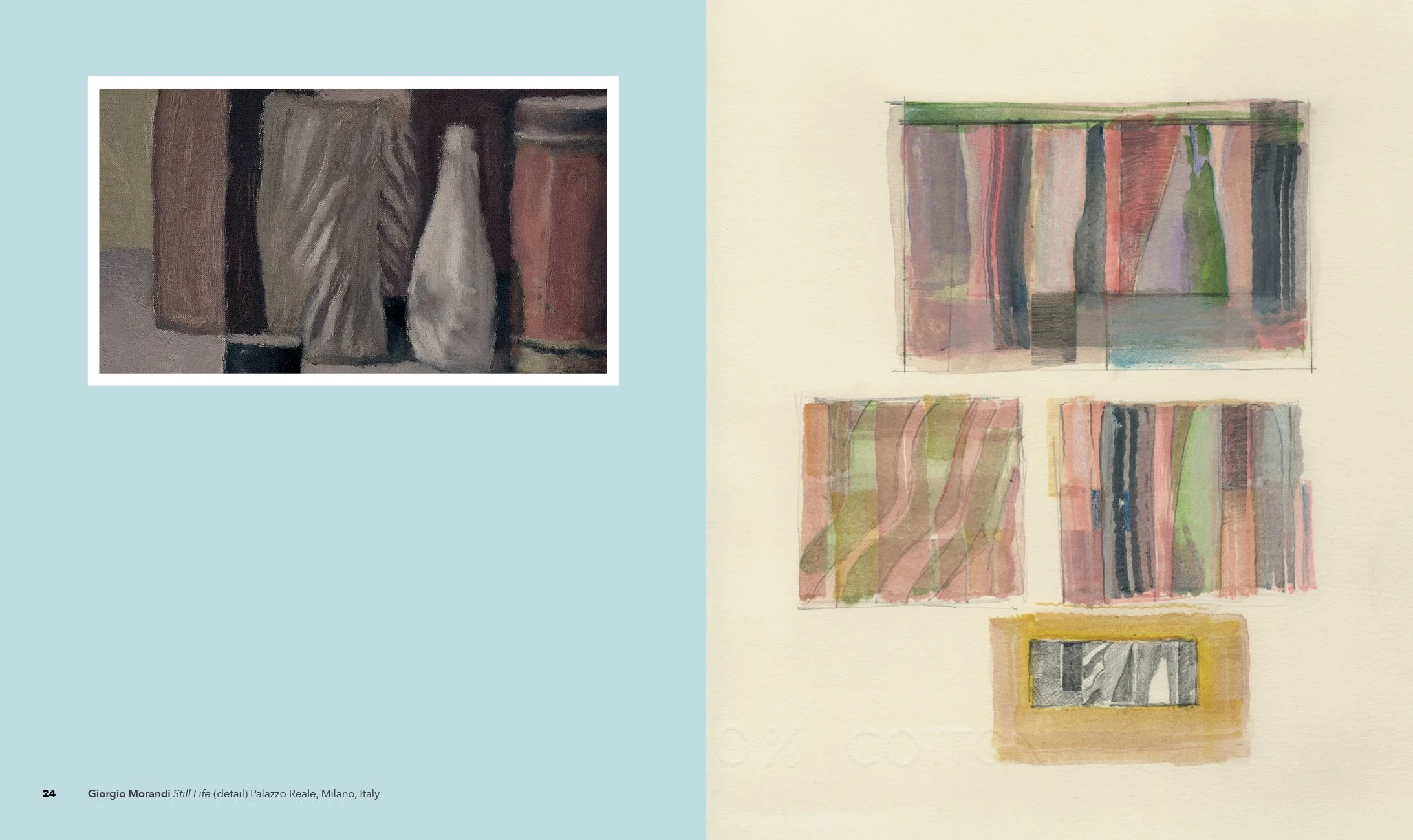
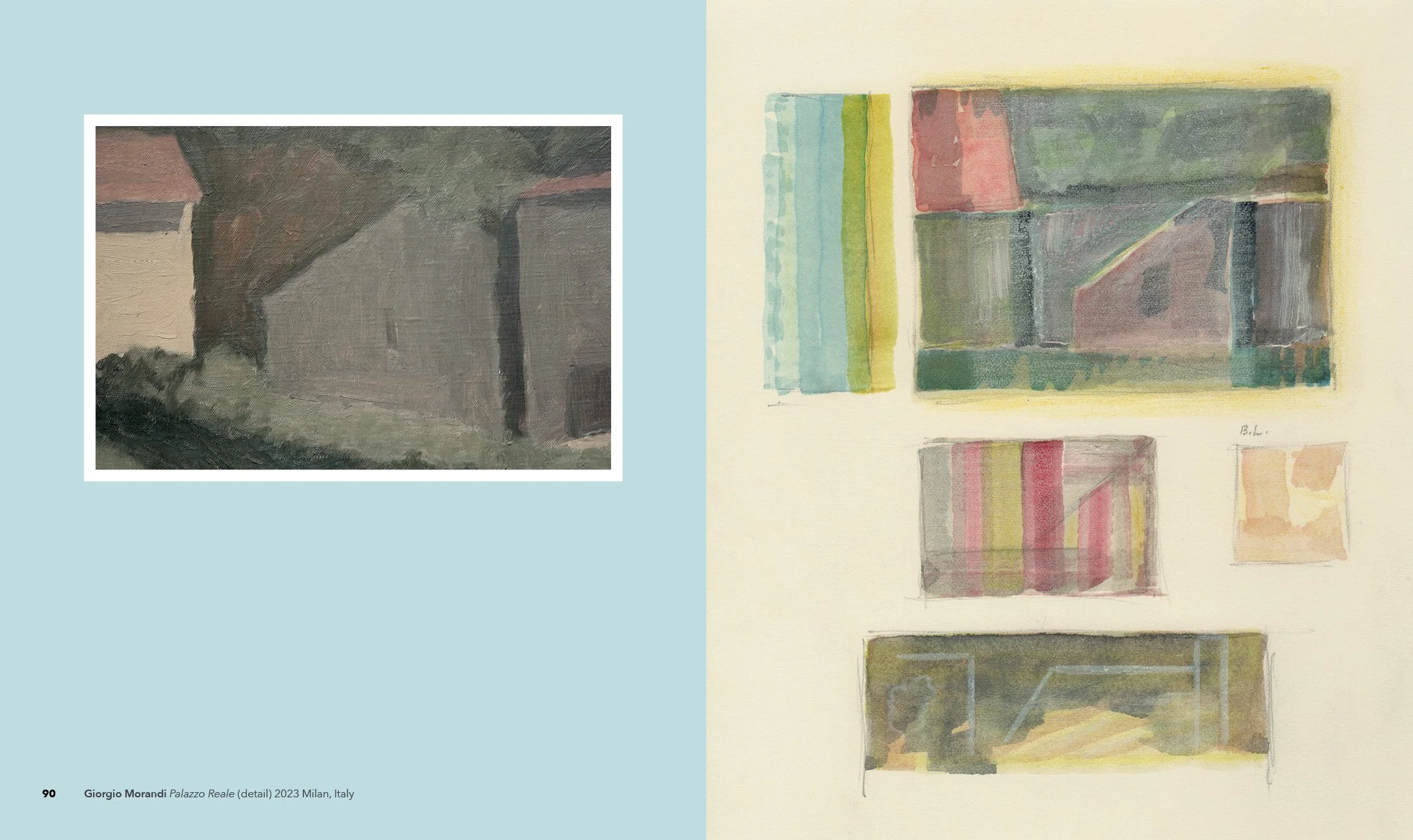
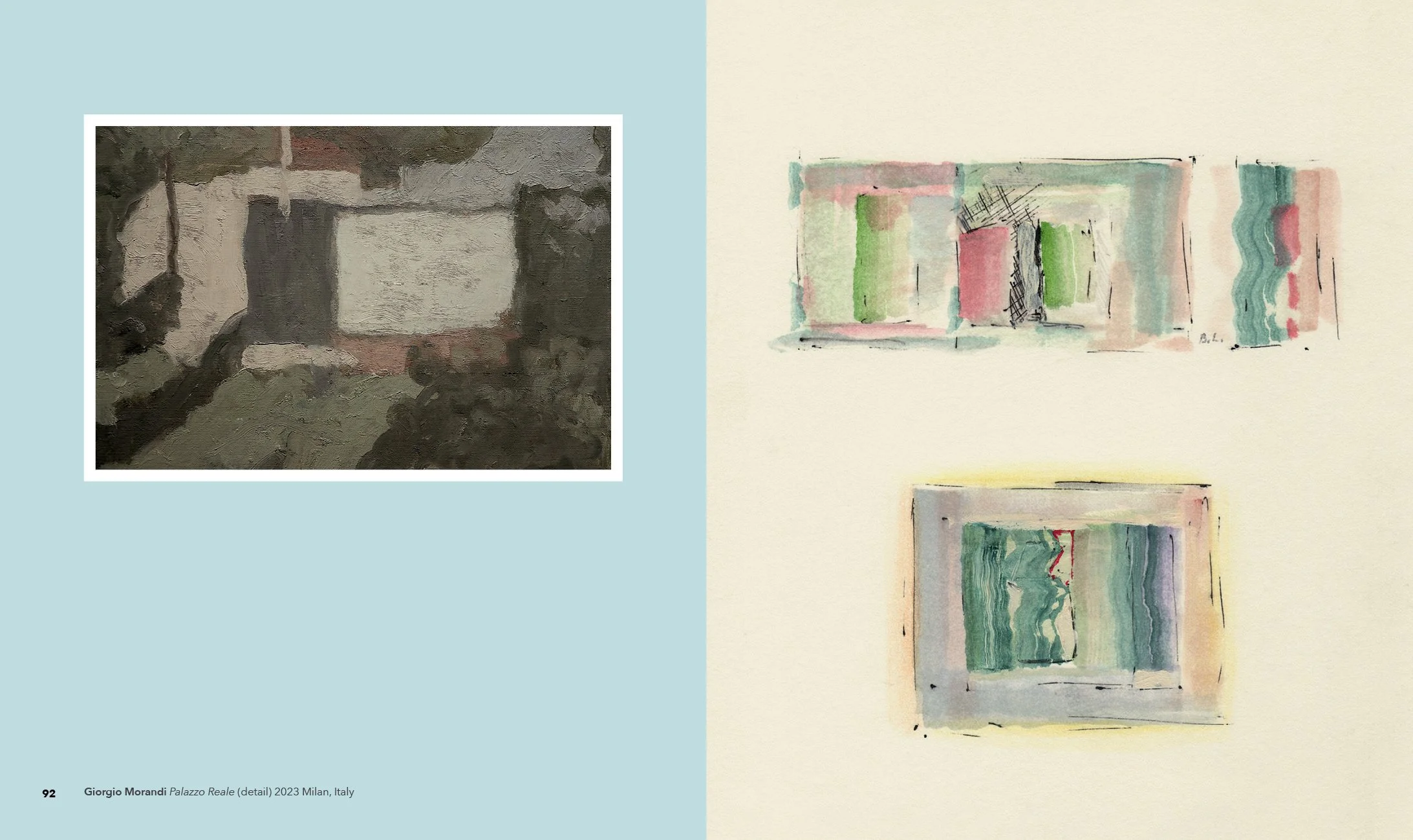
After we have looked at the images in the book, we might realise that Bruno Leti, while guiding us through his world, has also provided us with a lesson in seeing.
Seeing is the more important part of looking. For an artist, seeing is the act of transferring the outer world into the inner world. It is the essence of what we decide to keep, from the endless ephemeral information that enters our eyes when they are open. Seeing is related to the imagination which is connected to the creation of works of art.
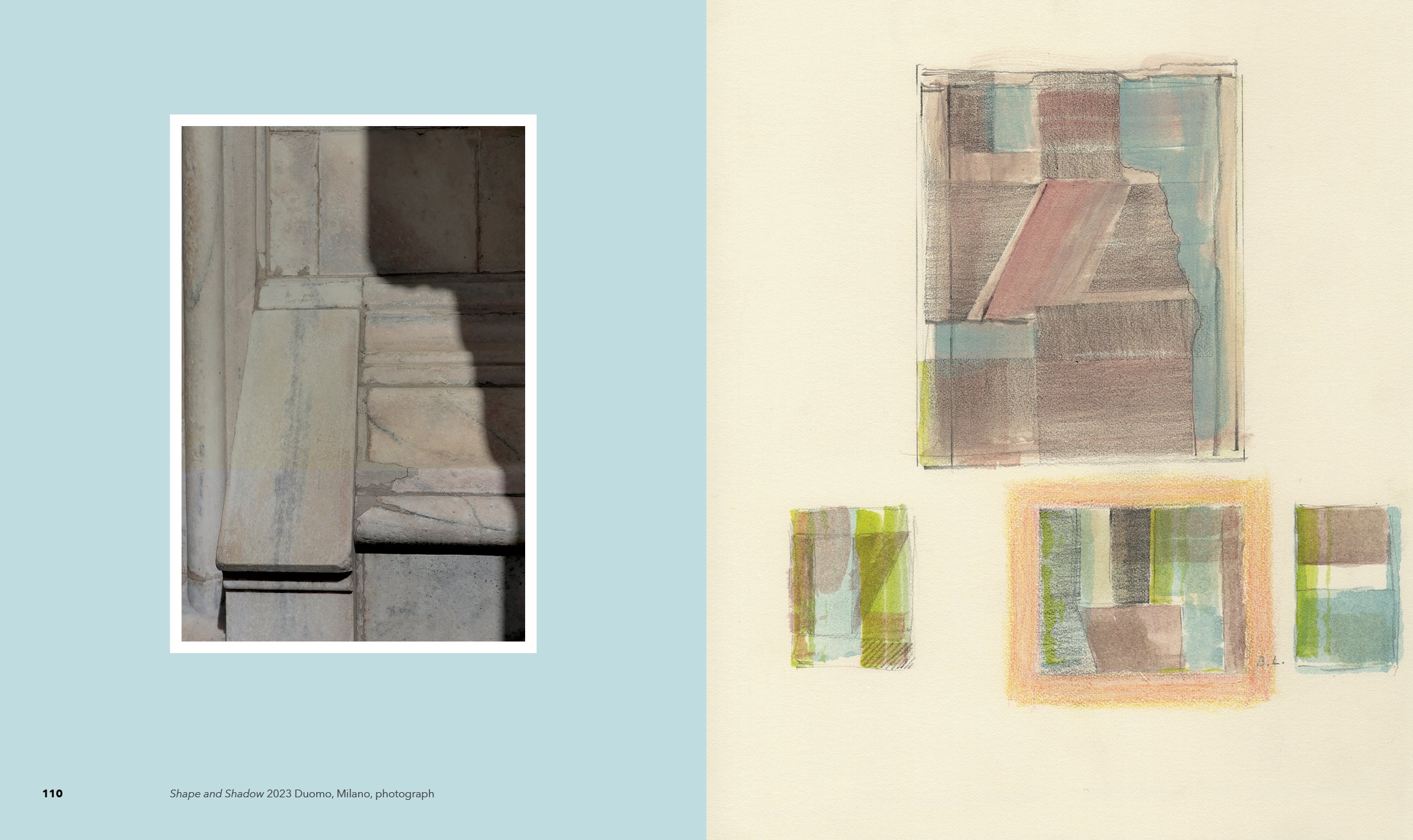
Seeing is a non-verbal part of this activity. In looking, when we see a tree or a door, we just provide the word that describes what we have seen, and stop looking. But when Bruno Leti shows a detail of a scene like Shapes and Shadows on page 110 (see above), we are challenged because we cannot provide a word for what we are looking at, and have to look more closely to decode the image. The image is of a three dimensional object rendered into two dimensional shapes which is not how we generally see the world. We know the world as a three dimensional space into which we venture every day. To consider it in this other way, is to see it in abstract terms.
After we have examined the photographs and the details and become acquainted with the visual geometry Leti has provided for us, we then need to turn back to the beginning of the book and read the quote that Leti has put there for us, which tells us how Galileo described the universe.
Bruno Leti’s own paintings which follow this same line of abstract thought, are also at the beginning and introduce us to his painter’s vision: “ Field of Dreams” diptych 2023 and the earlier Clunes Loggia 1995, so perfectly photographed, revealing the rich colour and texture of this beautiful painting. There are other examples of the artist’s work later in the book, which ends with the artist looking at us from the image in a circular mirror, camera in hand, perhaps hinting to us that it is his world that we have travelled through and discovered.
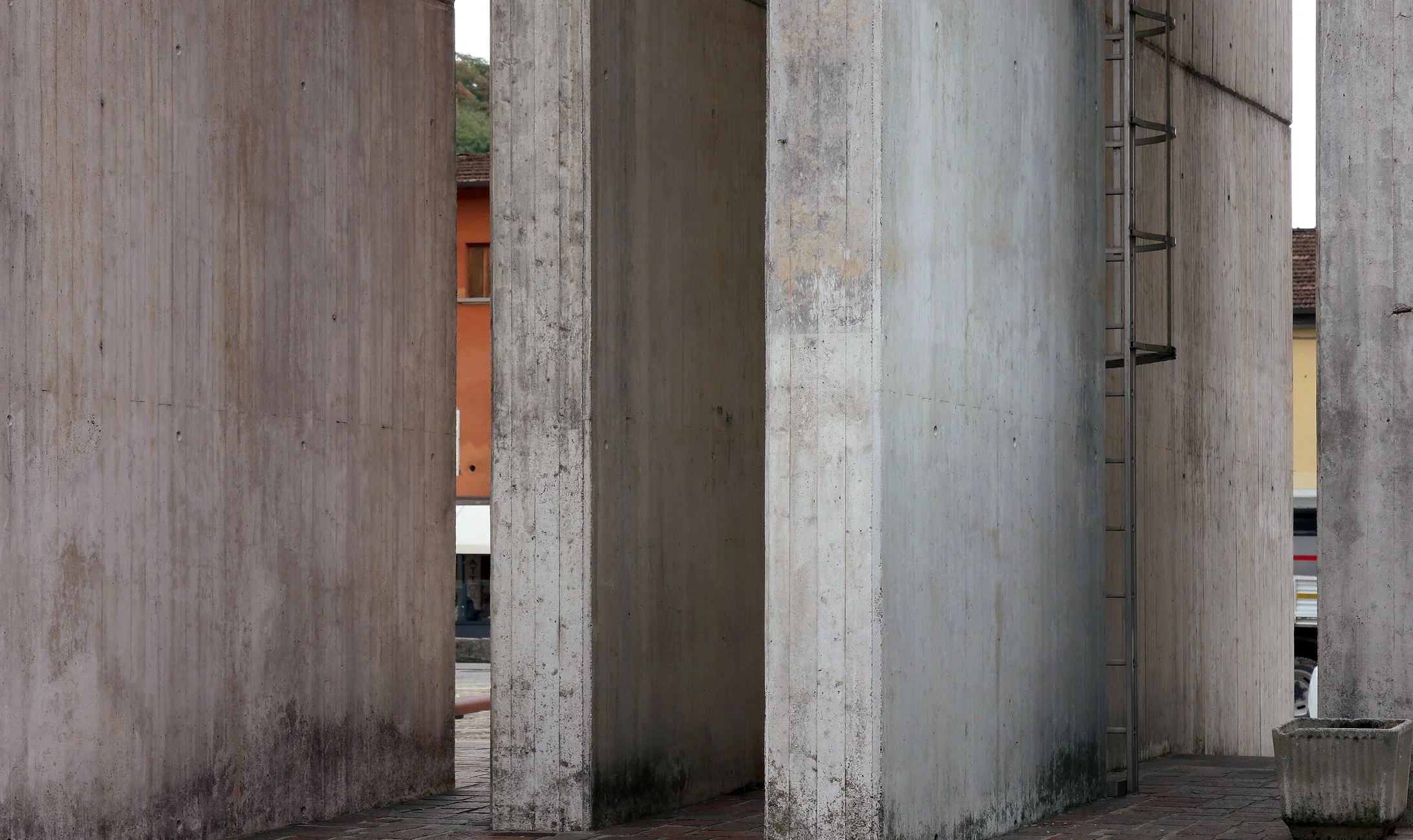
There is a variety of photographs included in this little book, but I think that none is more fascinating then the one across two pages (see above) which is of the Base of Bell Tower, Vergato. Here, we are presented with an image where the world seems to be on the other side of the massive grey barriers which hide it from us. It exists on the other side to where we are. The evidence, is two very narrow strips which acquire a magical attraction by the contrast against the grey walls. And how beautiful and precious is this evidence of the world on the other side. This imaginative photograph has, very cleverly, been transformed by Leti into a subtle allegory of Life.
Poetic Experiments: the shape of allegory by Bruno Leti, with an introduction by Des Crowley
Wartime Quilts in The New York Times best art books of 2017 list.
It all begins with an idea.

